


Iran says it hits US-linked targets as Bahrain reports drone attack
Iran says it hits US-linked targets as Bahrain reports drone attack

By Eman Abouhassira and Jana ChoukeirSat, June 27, 2026 at 9:25 AM UTC
0
By Eman Abouhassira and Jana Choukeir
DUBAI/WASHINGTON, June 27 (Reuters) - Iran said it struck targets linked to U.S. forces on Saturday in response to U.S. airstrikes on its southern coast, as each side continued to accuse the other of violating last week's agreement meant to end the four-month-old war.
Iran's foreign ministry did not identify the locations of its "defensive" attacks, which it said were a response to "the barbaric air strikes" by the U.S. on its coastal surveillance facilities, which it said also violated the U.N. Charter.
Later, Bahrain, which hosts the U.S. Navy's Fifth Fleet, condemned what it said was an Iranian drone attack on its territory as a flagrant violation of its sovereignty and a threat to its security, adding that it reserved the right to defend itself.
Washington did not immediately respond to Iran's report of striking American targets, a tactic that has sought to undermine U.S. allies in the region during the conflict.
The U.S. military said its strikes on Friday had been a response to an Iranian drone strike on a cargo ship in the Strait of Hormuz, a waterway vital to global energy supplies.
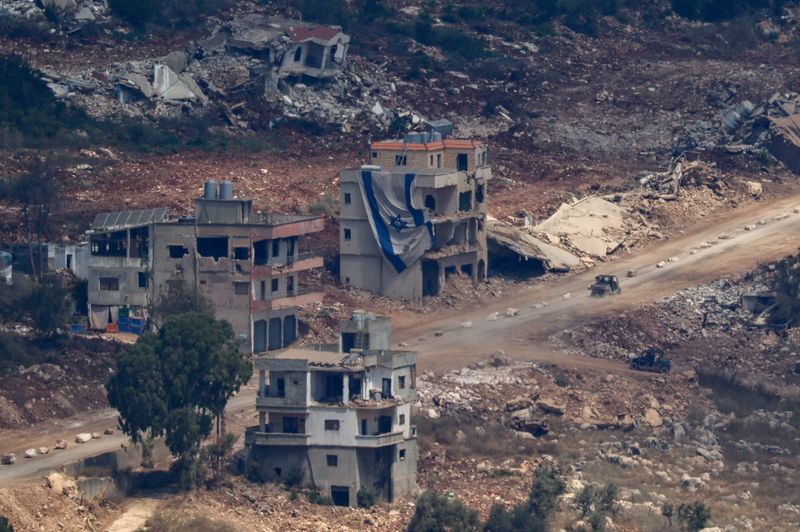
In one separate development, Israel and Lebanon signed an agreement to end the fighting between Israel and Iran-backed Hezbollah. Both sides said the deal was an initial step that calls for Hezbollah to disarm and Israel to withdraw troops from Lebanon, but it was not clear how it would be enforced. Hezbollah said it would not cooperate.
Iranian state television said the country's Revolutionary Guards had delivered "a decisive response" after U.S. forces hit a communications tower in the port city of Sirik. Iran's Mehr news agency said the port was operating normally with no damage reported to facilities or equipment.
Bahrain said Iran's continued attacks, despite regional and international de-escalation efforts, were undermining peace and regional stability. It also accused Tehran of breaching U.N. Security Council Resolution 2817 and the June 17 Islamabad memorandum of understanding.
After Thursday's strike on a cargo ship off Oman's coast, Iran did not acknowledge responsibility. Instead, it asserted its authority to regulate shipping through the Strait of Hormuz, said vessels must comply with routes designated by Tehran, warned Gulf states against siding with Washington, and said the Iran-U.S. interim agreement gave it control over ship traffic through the strategic waterway.
Advertisement
Ebrahim Azizi, the head of the Iranian parliament's national security committee, said on Saturday that any violation of Iran's shipping instructions through the strait would be met decisively.
U.S. Central Command condemned what it said was Iran's Thursday strike as "unwarranted aggression against commercial shipping", adding the U.S. would continue to provide "safe passage coordination and support" to commercial vessels transiting the strait — the conduit of one-fifth of the world's oil and LNG supplies before the U.S. and Israel launched the war on February 28.
'VIOLENCE WILL BE MET WITH VIOLENCE,' VANCE SAYS
Vice President JD Vance, once seen as a sceptic on U.S. intervention in Iran but now a point person for President Donald Trump on the conflict, said the Americans have adhered to the ceasefire deal, also known as a memorandum of understanding.
"Iran signed a ceasefire agreement. We have honored it. If they have disagreements about how the MOU is being applied, they can pick up the phone. But violence will be met with violence," Vance said on X.
Before the renewed outbreak of violence, oil prices fell about 3% on Friday, on course for steep weekly losses as oil tankers have exited the Strait of Hormuz.
Saudi Aramco resumed crude loadings at its Ras Tanura terminal in the Gulf, the world's biggest oil port, after a nearly four-month halt, shipping data showed. Fertilizer shipments through the strait have also picked up, helping to assuage concerns about a spike in global food prices.
U.S. Secretary of State Marco Rubio — wrapping up a tour of the Gulf to reassure regional allies about the interim pact — issued a joint statement with the Gulf Cooperation Council calling for "free, unconditional, and unrestricted navigation" in the strait without tolls or "attempts to assert control."
Iran's foreign ministry said the strait should be governed by Iran and Oman, while Ali Akbar Velayati, top adviser to Iran's supreme leader, warned Washington's Gulf allies their survival depended on Tehran's tolerance.
(Reporting by Reuters bureaus; Writing by Daniel Trotta and William Mallard; Editing by Chris Reese and Alexander Smith)
Source: “AOL Breaking”
